
Dealing with setbacks, rejections, obstacles, and failures the right way

You can’t get a hit unless you swing unless you’re in the game.
You just have to keep swinging no matter how often you fail.
This simple truth is one of the biggest factors that sets losers and winners apart.
Losers try something once, maybe twice, and when they don’t see the results they were hoping for, they give up.
You can observe this in any sport. Some players get discouraged when they fail to score. Their head drops and they stop trying. Naturally, they won’t score at any point after that.
Other players just keep going no matter what. They try again and again until eventually, they do get lucky.
The exact same dynamic is at play in any real-life “game”, ranging from business to relationships, as well.
That’s the one big secret. It’s always a numbers game.
To quote Jeff Bezos:
“Given a ten percent chance of a 100 times payoff, you should take that bet every time. But you’re still going to be wrong nine times out of ten. We all know that if you swing for the fences, you’re going to strike out a lot, but you’re also going to hit some home runs. The difference between baseball and business, however, is that baseball has a truncated outcome distribution. When you swing, no matter how well you connect with the ball, the most runs you can get is four. In business, every once in a while, when you step up to the plate, you can score 1,000 runs. This long-tailed distribution of returns is why it’s important to be bold. Big winners pay for so many experiments.”
Now it’s of course very easy to read something like this and nod your head in agreement. But actually internalizing and applying these ideas is a completely different story.
It also doesn’t help that all we see on social media is the big wins. The hundreds of failed attempts that came before are usually forgotten.
So the best you can do is study certain patterns that allow you to zoom out when things get tough.
For example, look at the famous startup curve:
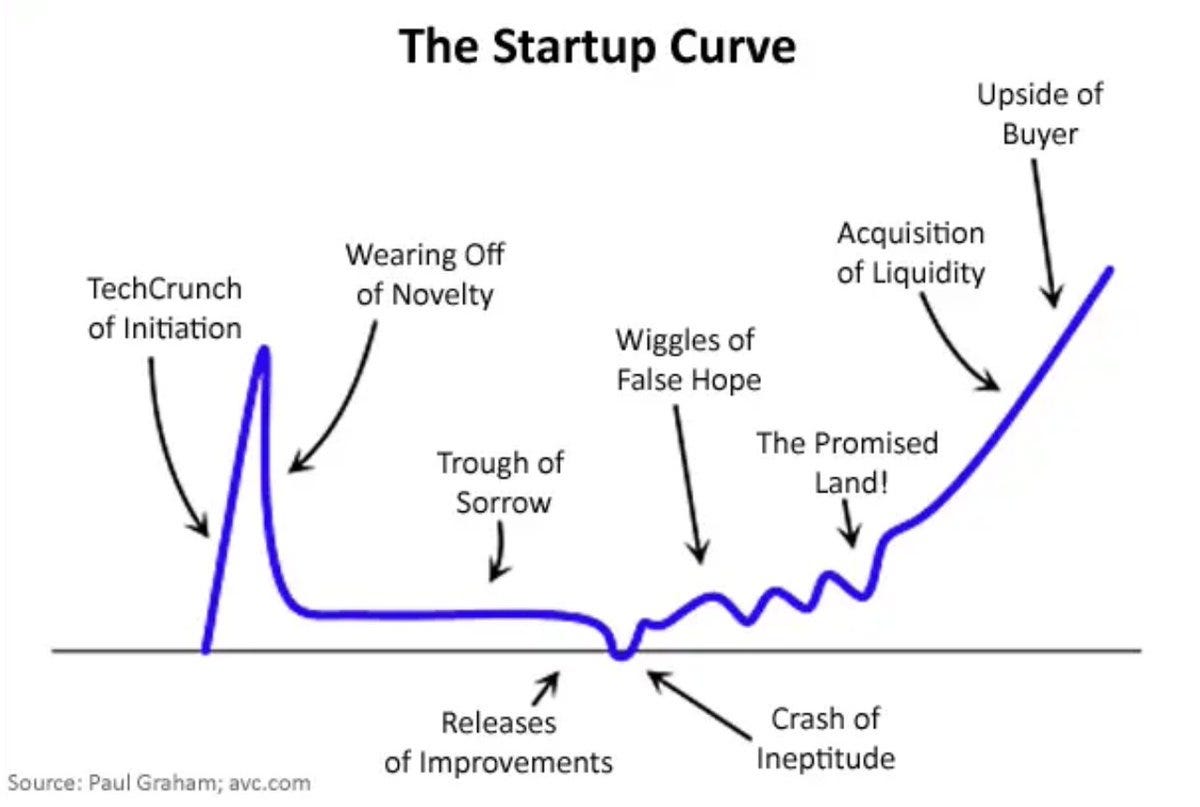
This is actually the emotional rollercoaster you will go through not just when you’re starting a startup, but in most real-world projects.
There’s always a honeymoon phase with tons of initial excitement, followed by a trough of sorrow, with eventual wiggles of false hope showing up, until you reach the promised land where steady results set in.
Most people give up when they encounter the trough of sorrow.
Progress stops. Motivation drops. Fuck this. I’m going to go do something else instead.
But the most successful people understand how progress actually happens.
When they hit a plateau, they don’t panic, they don’t quit.
They simply say “ah…a plateau….to be expected.” They greet plateaus like an old friend. Part & parcel of the journey.
This is of course yet another instance of reframing things in a more productive way.
Reframing plateaus as inevitable parts of any growth journey is incredibly liberating.
In any worthwhile pursuit, you will eventually feel like you hit a wall. You can’t move forward. You got blocked.
But in reality, it’s not a wall. It’s a plateau.
Winners expect plateaus to occur (they always happen when pursuing growth), and greet them like an old friend. “Ah, Mr plateau. I thought I’d be seeing you soon!”
They embrace the plateau instead of stressing out about it.
“Great, this is an opportunity to try something new!”
“This is pushing me to get more creative!”
“This is a chance to sharpen up my skills and learn more”
And no matter how bad the situation is, you can always say to yourself:
“This is going to make for an incredible story later.”
The same is true for each individual failure and rejection.
Losers take it personally.
“I failed so I’m a failure.”
“I got rejected, so there’s something wrong with me.”
This kind of thinking is not only counterproductive but also false.
There’s always an element of luck involved. No matter how smart, beautiful, or well-prepared you are, you will fail at times.
Even the best athletes in the world fail all the time as Michael Jordan famously observed:
“I've missed more than 9000 shots in my career. I've lost almost 300 games. 26 times, I've been trusted to take the game winning shot and missed. I've failed over and over and over again in my life. And that is why I succeed.”
That’s the correct mindset, no matter if you’re trying to make progress in your career, build a better network or profitable business, or find your soulmate.
Keep launching businesses until one finally takes off. The one big winner will pay for all previous failed experiments.
Keep putting yourself out there and approaching people until you find your soulmate. You only need to succeed once and the hundreds of awkward rejections will be quickly forgotten once you do.
Keep doing nice things for other people without expecting anything in return. Most will never do anything for you or even say thanks. But 1 out of 100 people you're friendly and gracious to are going to become amazing friends and confidants and colleagues. And this alone makes it all totally worth it.
You’re only a failure if you give up.
And true winners actually frame each failure as a very real step forward.
I remember reading about a car company (probably Toyota) that dramatically improved its products through a small shift in focus.
The obvious approach is to try to decrease the number of problems that occur as much as possible.
But what they did instead was tell their quality control testers to find at least 5 ways to break their cars each month.
So while other companies want the number of problems detected to decrease, they were looking for a constant line.
This makes a ton of sense because the naive approach leads to wrong incentives.
If the goal is to decrease the number of problems detected, quality testers will be motivated to stop looking as hard as they can. This will help to make sure their bosses are able to include the charts they’re looking for in their PowerPoint presentations. But it will of course not help to make the products maximally reliable.
I was facing a similar dilemma not too long ago.
At first glance, it makes sense to try to minimize my failure rate, my rejection rate, and the number of people I offend each day.
Failure, rejections, and mean replies are painful. And every time I’m decreasing my failure rate, my success rate goes up.
This kind of thinking is of course fatally flawed.
After all, the best way to minimize your failure rate is to simply do nothing.
A slightly less obvious problem with my focus on succeeding more and failing less is that it motivates me to seek out easy wins.
If I’m launching yet another free project on Product Hunt, it’ll most likely be a “success”. People will reward my efforts with upvotes and nice comments.
But when I’m launching a new premium offer, there’s a very real possibility it will flop completely.
Similarly, there’s an easy way to improve my success rate when it comes to cold outreach by simply reaching out to people a few levels “below me”.
Here’s a concrete example. I recently started experimenting with cross-promotions to grow my newsletter. My natural instinct was to reach out to newsletter writers with fewer subscribers than me. Almost all of them said yes! But frankly, none of these cross-promotions really moved the needle in a meaningful way for me.
To make cross-promotions work I definitely should start reaching out to people with a similar or larger number of subscribers. But when I’m doing this, I will definitely get a lot of rejections.
Another area where I’m 100% guilty of doing the same mistake is when it comes to posting content online. I’m writing dozens of tweets, blog posts, and newsletters without mentioning my products once.
Stupid, I know. I definitely would be better off shamelessly promoting my own stuff even if that means offending a few people here and there.
Now that I noticed these patterns the solution seems straightforward.
Instead of focusing on successes and positive replies, I have to start hunting failures and rejections.
Here’s another useful way to frame this idea:
You’re 100 rejections, 100 mean comments, 100 failed experiments away from reaching your goals. And it’s entirely up to you how fast you get through them.